arXiv:2603.15445 · cs.RO
CASE 2026 · Best Paper Award Finalist

Zero-Shot Generalization from Motion Demonstrations to New Tasks

A handful of isolated demonstrations, reinterpreted as a graph, becomes a reactive and provably stable policy for tasks that were never shown.

Kilian Freitag1* Alvin Combrink1* Nadia Figueroa2
* Equal contribution 1 Chalmers University of Technology 2 GRASP Lab, University of Pennsylvania
scroll
TL;DR

Demonstrations for different tasks share the same workspace. We treat the Gaussian components of learned motion primitives as vertices of a graph, then search that graph to stitch and chain old motions into new ones — no retraining, no new data, and stability is preserved.

How it works

Four stages from demonstrations to a new policy

Each stage consumes what the previous one produced, bridging continuous control with discrete graph search.

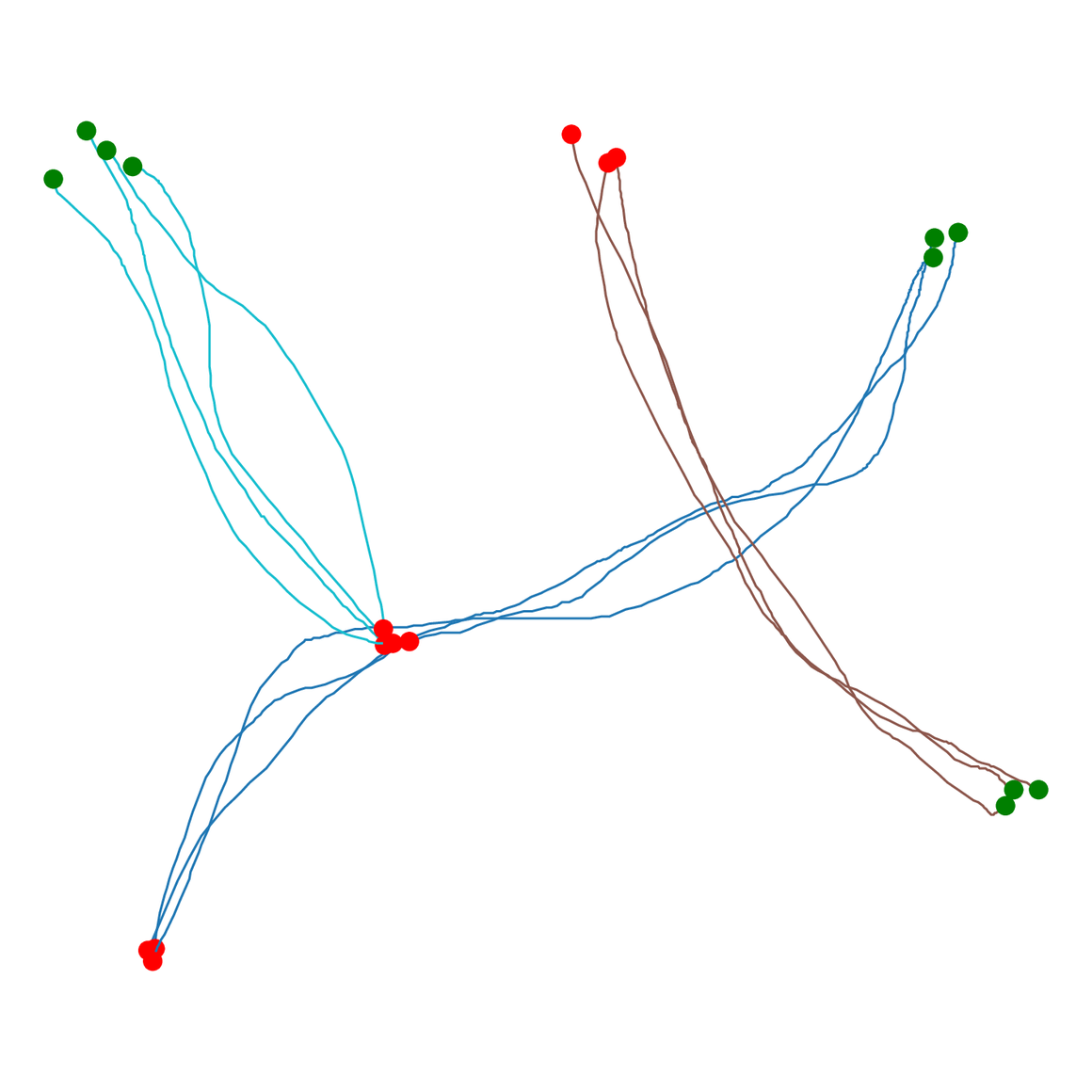
  1. Raw expert trajectories for separate tasks in one workspace
    STAGE 01

    Demonstrations

    A few expert trajectories per task, collected in one shared workspace.

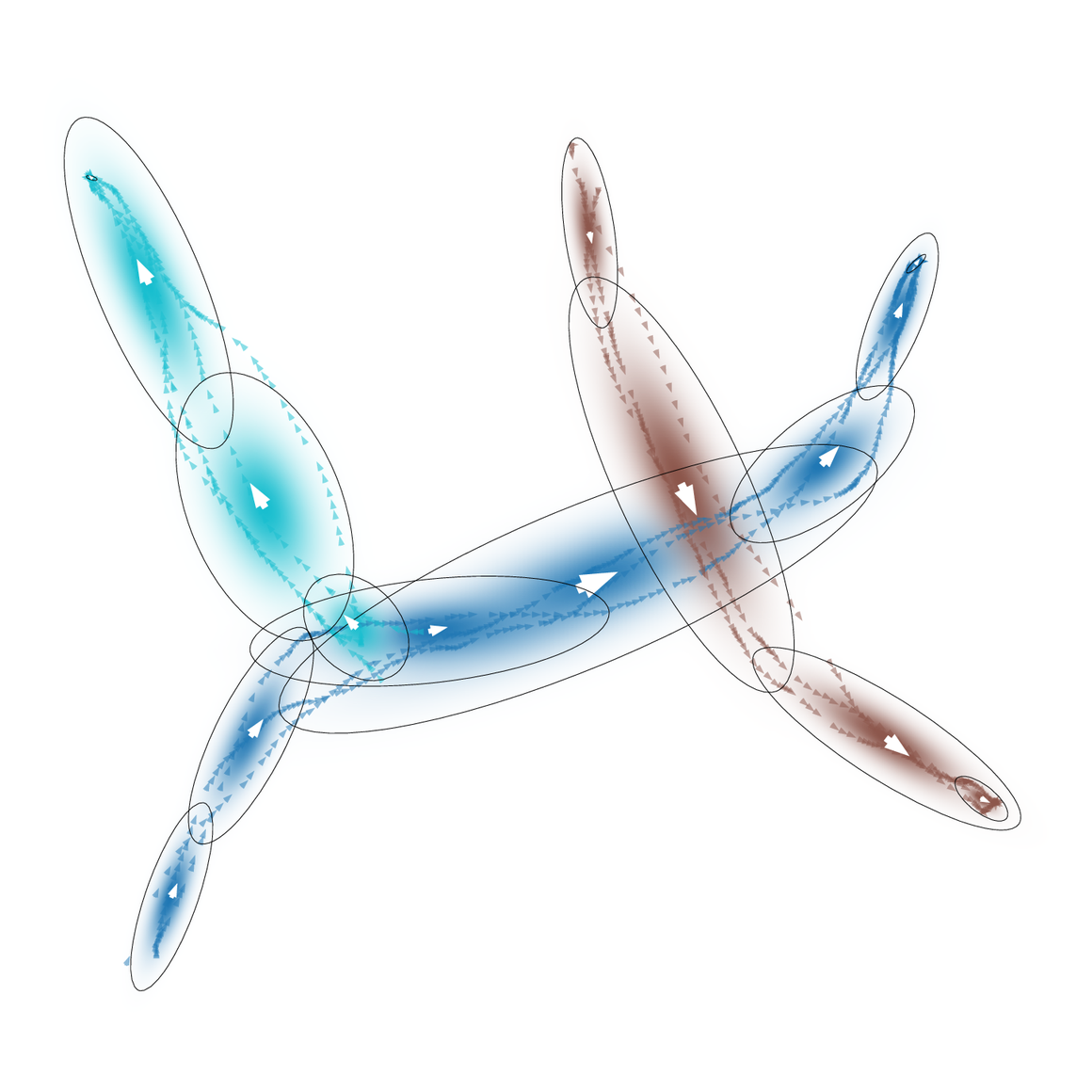
  2. Gaussian mixtures fitted over the demonstrations with directional arrows
    STAGE 02

    Gaussian mixture

    Fit locally linear motion primitives — the Gaussians summarizing each demonstration.

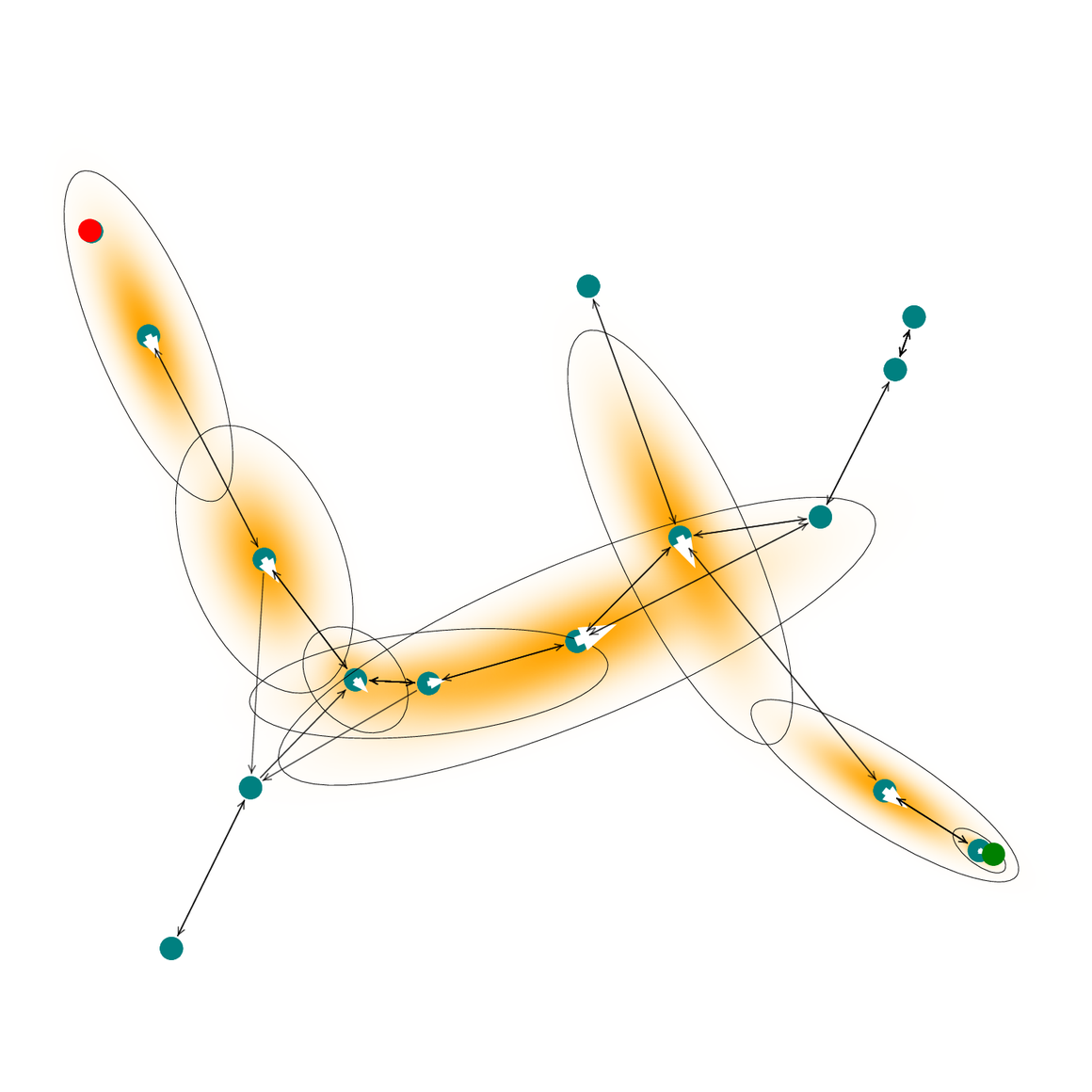
  3. The Gaussian Graph with nodes, edges, and a searched path from start to goal
    STAGE 03

    Gaussian Graph

    Each Gaussian becomes a vertex; search the graph for a path from start to goal.

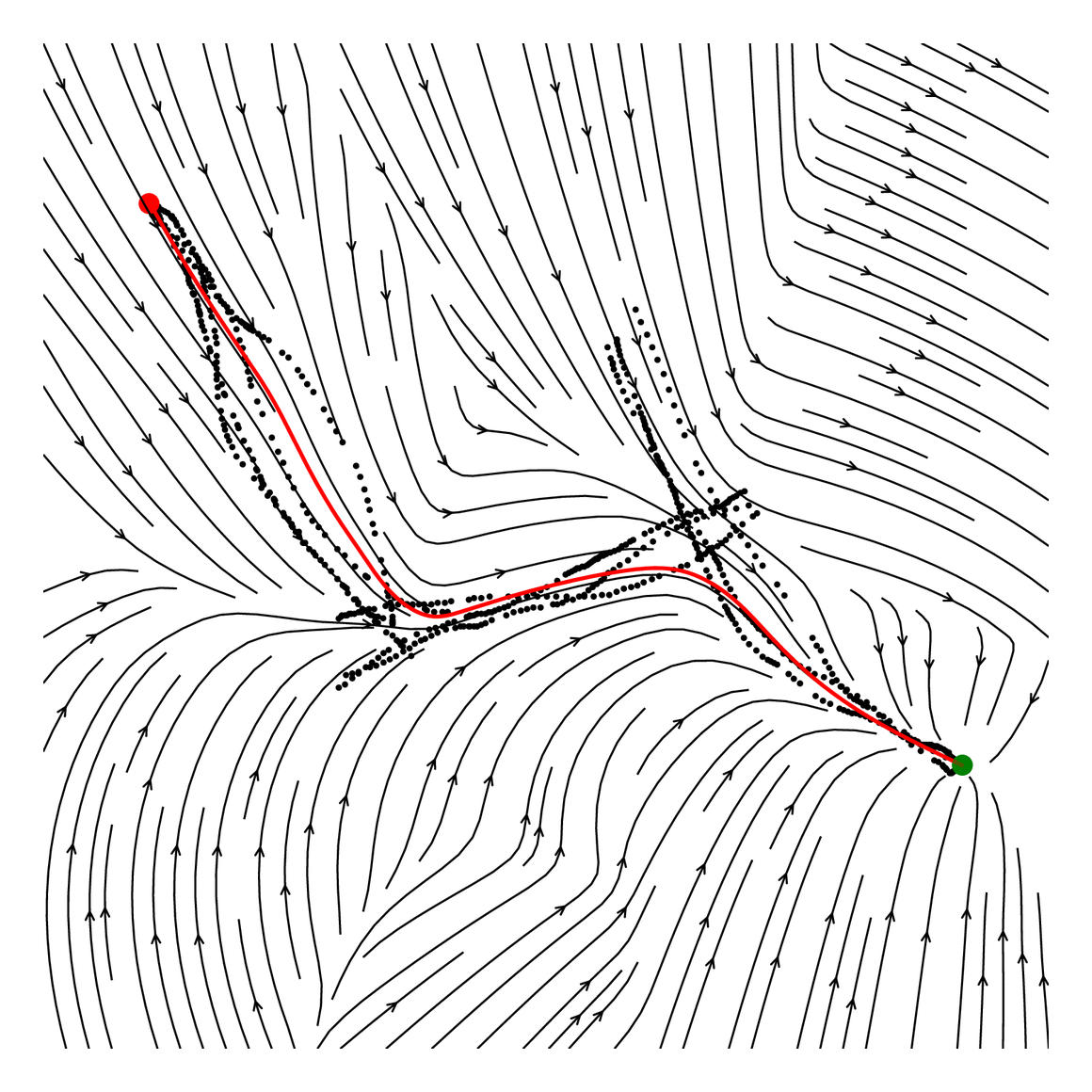
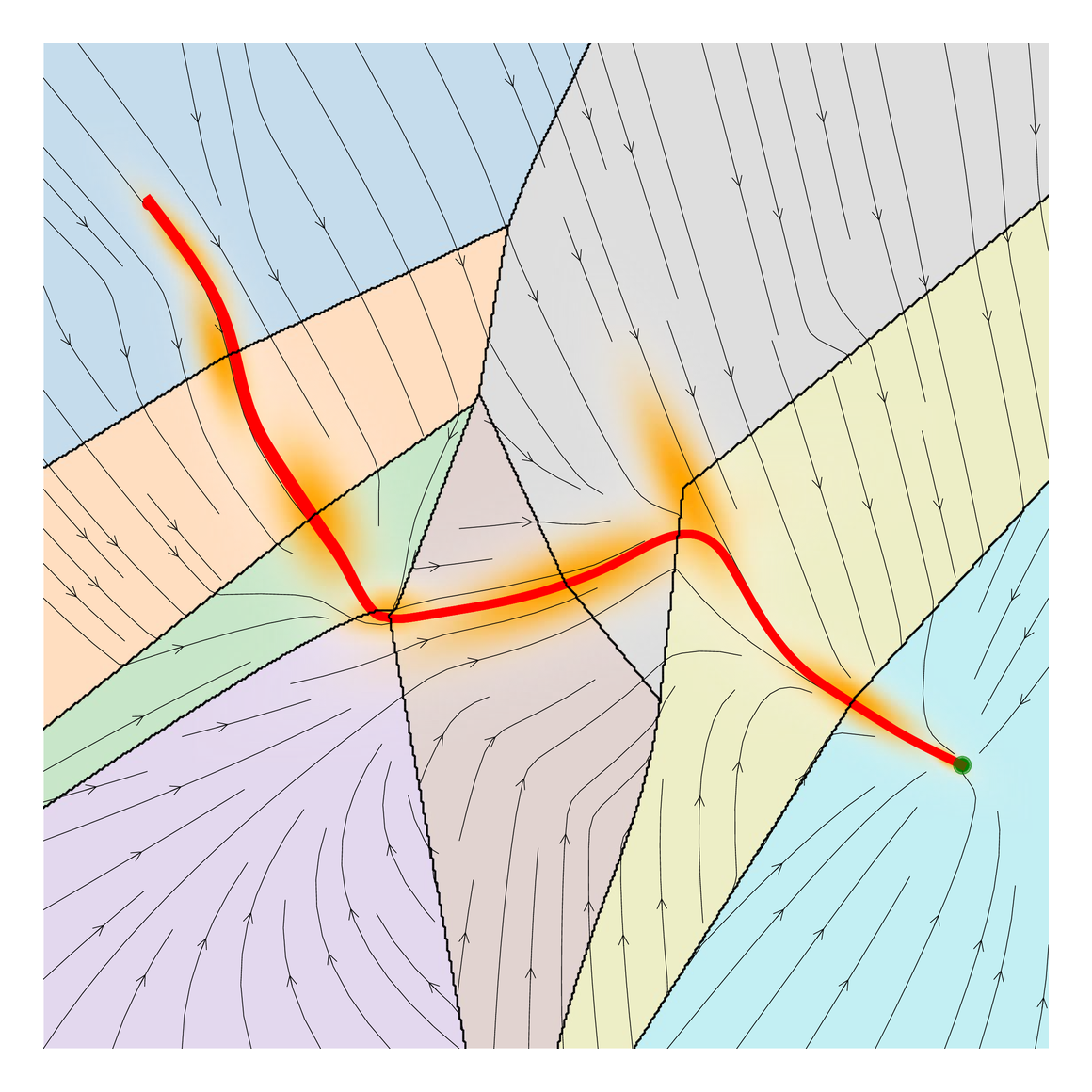
  4. Stitched dynamical system streamlines converging to the goal along the path
    STAGE 04

    Stitched DS

    Realize the path as a stable dynamical system that flows to the goal from anywhere.
Input · what the robot was shown

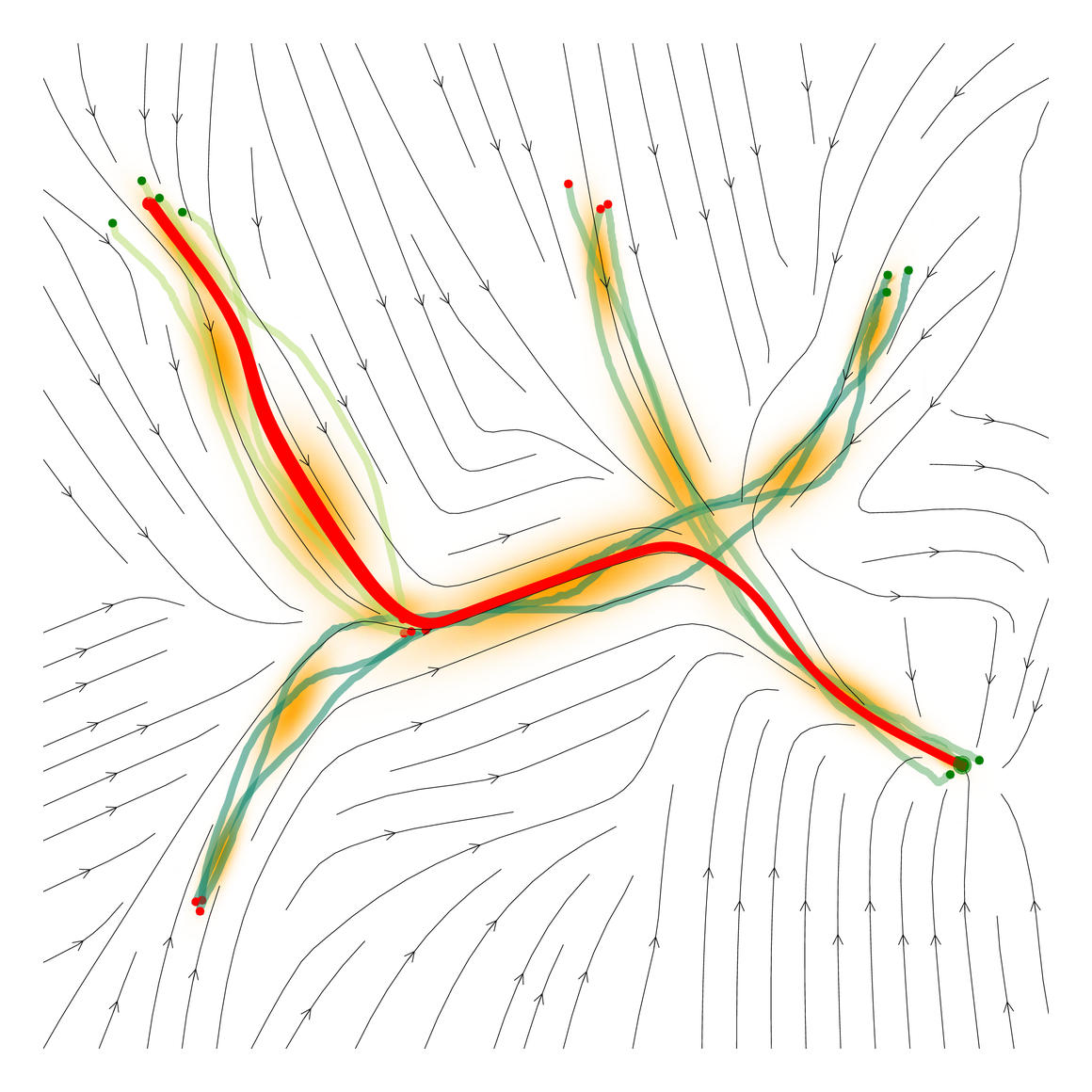
Three isolated demonstrations

Each demonstration solves a single, self-contained task in the shared workspace. On their own, they don't transfer to new start–goal pairs.

Demonstration
Task 01
Demonstration
Task 02
Demonstration
Task 03
Output · zero-shot

Two new tasks, solved by combining the demonstrations

Neither task below was ever demonstrated. Both are produced by searching the Gaussian Graph and chaining the primitives — reactive, convergent, and stable throughout.

Chained result
New task 01
never demonstrated
Chained result
New task 02
never demonstrated
Two frameworks, one graph

Stitching and Chaining

The Gaussian Graph supports two ways to assemble a new policy — a single time-invariant field, or an ordered sequence of motions. Both are globally asymptotically stable, provably converging to the goal.

Stitched dynamical system: one streamline field converging to the goal
// Stitching

One time-invariant DS

Merge the primitives along a graph path into a single Linear Parameter Varying dynamical system that flows to the goal from anywhere in its basin.

  • Reactive to perturbations at every point in the workspace
  • No notion of ordering — one smooth field
  • Best when the new task is a direct start-to-goal motion
Chained dynamical system: a sequence of DS segments handing off toward the goal
// Chaining

A sequence of DSs

Fit one linear DS per node on the path and switch or blend between them online, composing complex motions that a single field can't represent.

  • Handles long-horizon complex motions
  • Online switching / blending between segments
  • Stable hand-off at every transition
Abstract

Learning motion policies from expert demonstrations is an essential paradigm in modern robotics. While end-to-end models aim for broad generalization, they require large datasets and computationally heavy inference. Conversely, learning dynamical systems (DS) provides fast, reactive, and provably stable control from very few demonstrations. However, existing DS learning methods typically model isolated tasks and struggle to reuse demonstrations for novel behaviors.

In this work, we formalize the problem of combining isolated demonstrations within a shared workspace to enable generalization to unseen tasks. The Gaussian Graph is introduced, which reinterprets spatial components of learned motion primitives as discrete vertices with connections to one another. This formulation allows us to bridge continuous control with discrete graph search. We propose two frameworks leveraging this graph: Stitching, for constructing time-invariant DSs, and Chaining, giving a sequence-based DS for complex motions while retaining convergence guarantees. Simulations and real-robot experiments show that these methods successfully generalize to new tasks where baseline methods fail.

Cite this work
@article{freitag2026zeroshot,
  title   = {Zero-Shot Generalization from Motion Demonstrations to New Tasks},
  author  = {Freitag, Kilian and Combrink, Alvin and Figueroa, Nadia},
  journal = {arXiv preprint arXiv:2603.15445},
  year    = {2026}
}